
The growing conversation around AI for financial advisors tends to focus on what the technology can do. For advisory firms, there may be a more practical question: What work can AI take off an advisor’s plate?
When technology reduces administrative work, advisors have more time to prepare for meetings, follow up with clients, solve problems, and maintain the relationships that are central to their business. That is where AI can offer real value.
Financial advice depends on good information, but clients are still working with people. Technology should give advisors more room to do that part of the job well.

Advisors Want AI to Help Them Work More Efficiently
The 2025 Kitces AdvisorTech Study gives us a useful picture of how advisors are approaching artificial intelligence.
Advisors showed the most optimism around AI improving operational efficiency. They were less enthusiastic about using AI to directly handle the client experience. Client service was also the only one of seven business functions surveyed where a majority of advisors showed no interest in using AI.
That tells us something important about financial advisor AI tools.
Advisors are interested in tools that help them work faster, organize information, and reduce repetitive tasks. They are much more cautious when technology begins taking over communication or other parts of the client relationship.
That makes sense. Efficiency can support the advisor-client relationship, but clients still expect their advisor to understand their situation, answer questions, and make thoughtful decisions with them.
AI Can Give Advisors More Time for Clients
There are many places where AI in wealth management can reduce the amount of administrative work an advisory team has to handle.
AI can help summarize meeting notes, organize action items, review documents, prepare information before meetings, assist with financial plans, draft internal notes, and help teams identify follow-up tasks.
Client meeting technology is a good example. AI-powered tools can record notes, create summaries, and identify action items after a meeting. Instead of spending additional time reconstructing a conversation or manually creating a list of next steps, an advisor can review the information and move on to the work that requires personal attention.
Scheduling technology can remove another small, but repetitive, task. Clients can select available meeting times without several rounds of email. Workflow systems can then make sure follow-up tasks are assigned to the right person.
This is where advisor technology becomes especially useful. It clears away some of the work surrounding the client relationship so advisors can spend more time actually serving the client.
Human Judgment Still Matters
There are parts of financial advice that are difficult to automate because the numbers are only one part of the conversation.
Someone preparing for retirement may be worried about whether they will have enough money, but they may also be struggling with the idea of leaving a career that has defined much of their adult life.
A surviving spouse working through an estate may need accurate financial guidance, but the advisor also needs to understand the circumstances surrounding that conversation.
During a difficult market, a client may know what the financial plan says and still need to talk with someone they trust.
That is where human-in-the-loop automation becomes important.
AI can organize information, identify patterns, summarize conversations, or prepare a draft. The advisor still reviews the information, applies judgment, and decides how to communicate with the client.
That approach can create a better financial advisor client experience because technology improves the efficiency of the service without removing the advisor from the relationship.
The same idea is explored in Standing Out in a Sea of Robo-Advisors and Personalization That Scales. Technology works best when it helps advisors provide personal service more consistently.

Not Every Automation Needs Artificial Intelligence
There is also an important difference between AI automation and rules-based automation.
AI can analyze information, summarize content, and generate responses. Rules-based automation simply follows instructions that have already been established.
A client birthday is a good example.
The system does not need artificial intelligence to determine when someone’s birthday occurs. It simply needs accurate client information and instructions about what should happen when that date approaches.
The same applies to holiday mailings, anniversaries, and other scheduled client touchpoints.
That’s part of the infrastructure we discuss in How to Build a Scalable Client Engagement System.
The purpose of automation is to make sure important things happen consistently. The advisor still decides what those interactions should look like and how they fit into the overall client relationship.
A Simple Rule of Thumb for AI in Financial Advisor Services
A good way to evaluate AI for financial advisors is to ask whether the technology creates more time and attention for the client relationship.
AI is most useful when it reduces repetitive work, organizes information, or helps an advisor prepare. The closer a task gets to personal advice, sensitive communication, or an important financial decision, the more important it becomes to keep the advisor directly involved.
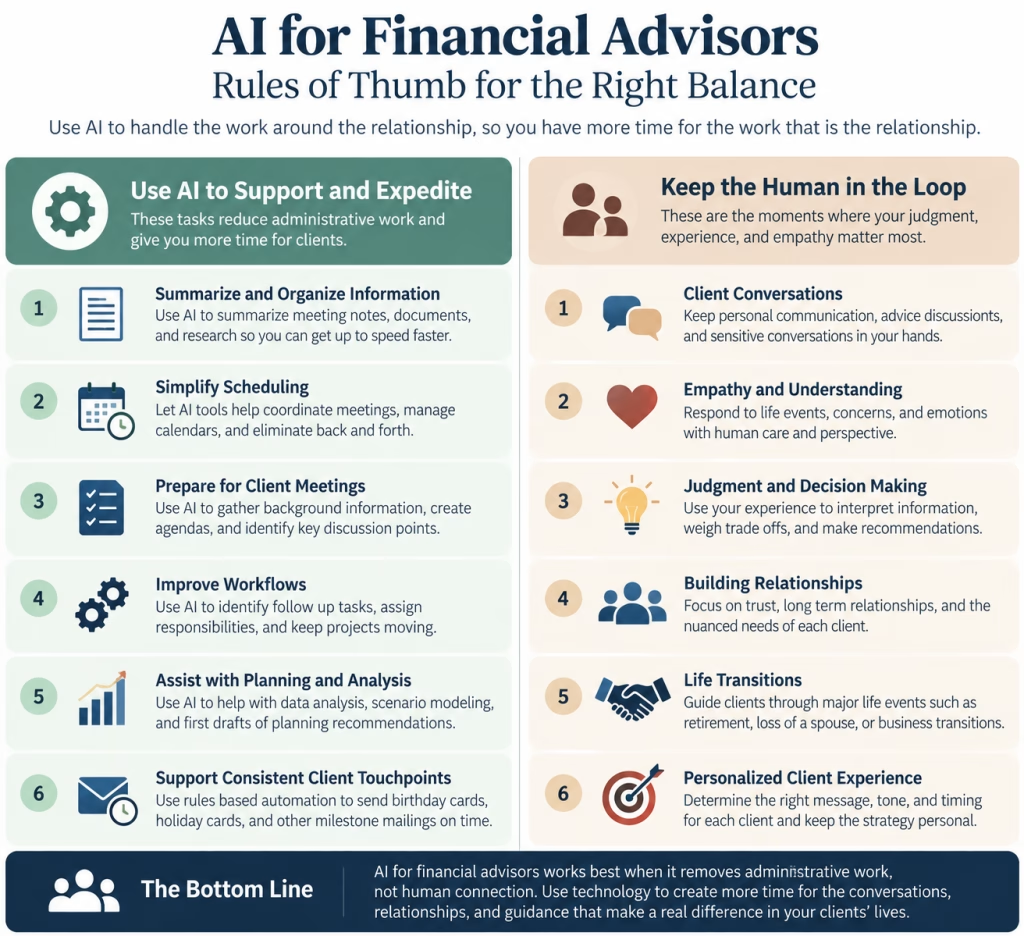
The basic idea is simple: use AI to support the work around the relationship, but keep the advisor at the center of the relationship itself. For a quick visual summary, see the infographic below.
Rules of Thumb for Using AI in Financial Advisor Services
- Use AI to prepare, not to make the final judgment.
Let AI summarize, organize, research, or create a first draft. The advisor should review the information and make the decision. - Automate repetitive administrative work first.
Meeting notes, document summaries, scheduling, task creation, and workflow support are natural places to look for efficiency. - Keep advisors involved in client-facing communication.
Messages involving financial advice, major decisions, market concerns, retirement, loss, or other sensitive situations should receive human review and judgment. - Use automation for consistency.
Rules-based systems are well suited for predictable tasks such as birthday cards, holiday mailings, anniversary recognition, reminders, and scheduled follow-up. - Do not automate something simply because you can.
The better question is whether automation improves the client experience or gives the advisor more time to serve clients well. - Protect the human moments.
When empathy, context, judgment, reassurance, or trust are central to the interaction, the advisor should remain at the center of it.
The simplest test may be this: Does the technology give the advisor more time to be an advisor? If it does, it’s probably being used in the right place.
Where The Birthday Company Fits
The Birthday Company follows this same approach.
With Financial Advisor Birthday Cards, advisors choose how clients should be recognized. They select the card, message, signature, branding, and overall approach. The Birthday Company handles the repetitive production work, including printing, addressing, postage, scheduling, and mailing.
The same type of system can support holiday cards, anniversaries, retirement recognition, sympathy messages, and other lifecycle occasions.
As discussed in Financial Advisor Client Engagement, those mailings work alongside meetings, phone calls, reviews, and other meaningful conversations.
As AI becomes more common, deciding where technology belongs will become increasingly important.
Advisory firms don’t necessarily need to automate everything they can. They need systems that save time without losing the personal attention clients deserve.
AI can reduce administrative work. Rules-based automation can create consistency. Advisors can use the time those systems save to listen, advise, communicate, and strengthen relationships.
That may be the most valuable opportunity for AI for financial advisors – creating more time for the human connection that makes financial advice personal.
Bibliography
- Kitces Research. The Technology That Independent Financial Advisors Actually Use and Like, Volume 1, 2025. Research on AdvisorTech adoption and AI for financial advisors, including operational efficiency, client service, AI adoption, and human involvement. Kitces 2025 AdvisorTech Study
- The Birthday Company. Financial Advisor Birthday Cards. Overview of rules-based card scheduling and personalized client mailings for financial advisory firms. Financial Advisor Birthday Cards
- The Birthday Company. How a Greeting Card Mailing Service Supports Financial Advisor Client Engagement. Discussion of recurring personal touchpoints and their role between substantive advisor interactions. Financial Advisor Client Engagement
- The Birthday Company. How to Build a Scalable Client Engagement System That Produces Measurable Results. Framework for using repeatable systems to support consistent client recognition. Scalable Client Engagement System
- The Birthday Company. Standing Out in a Sea of Robo-Advisors: How Human Touch Wins. Discussion of technology, automation, and preserving human connection in financial advisory relationships. Standing Out in a Sea of Robo-Advisors